Why pharmacy organizations, employers, health plans, and public-sector leaders need claim-level evidence to make stronger reimbursement and profitability decisions
Claims-level visibility improves financial decision-making because it shows how reimbursement, payer behavior, cost of goods, fees, rebates, spread-related economics, and gross margin are actually produced at the transaction level. Summary reports may show what happened in total. Claims-level analysis helps explain why it happened, where the financial pressure is coming from, and which actions should be prioritized.
For pharmacy organizations, claims-level visibility can reveal whether prescription volume is translating into margin, which payers are creating reimbursement pressure, and where below-cost claims or purchasing patterns are eroding profitability. For employers, health plans, public employee plans, and oversight stakeholders, it can support better review of PBM reporting, plan performance, compensation flows, and reimbursement integrity.
The need is growing because pharmacy benefit economics are becoming more difficult to interpret from high-level data alone. NCPA’s 2025 Digest summary pointed to pressure from high cost of goods, GLP-1 and other high-cost prescriptions, low or below-cost third-party reimbursement, and inflation. FTC staff reports in 2024 and 2025 increased public scrutiny of PBM practices, specialty drug pricing, and pharmacy reimbursement dynamics. In 2026, the U.S. Department of Labor proposed PBM fee-disclosure rules intended to give self-insured group health plan fiduciaries clearer information about PBM compensation flows. Across these developments, the direction is clear: better financial decisions require better underlying visibility.
Key Takeaways
- Claims-level visibility helps organizations understand the specific transactions driving spend, reimbursement, margin, and financial risk.
- Aggregate reports can hide below-cost claims, payer variability, high-cost outliers, spread exposure, rebate and fee visibility gaps, and margin leakage.
- Better financial decision-making depends on knowing which claims, payers, stores, products, channels, or contracts deserve attention first.
- Claims-level analysis supports pharmacy profitability decisions, employer and plan sponsor oversight, public-sector stewardship, and payer performance review.
- Stratos Insights positions claims-level visibility as the foundation for reimbursement integrity, true profitability visibility, and prioritized financial action.
Featured definition: Claims-level visibility is the ability to analyze individual prescription claim records and related financial fields to understand how each transaction was reimbursed, paid, adjusted, and tied to cost or margin. It improves financial decision-making by connecting broad performance trends to the specific claims and reimbursement patterns that created them.
Why Aggregate Reports Are Not Enough
Aggregate reports are useful for seeing direction. They can show total claims, total pharmacy spend, total reimbursement, utilization trends, or average margin. But they often flatten the transaction-level variation that matters most for financial decisions.
A pharmacy group may see enterprise prescription volume increasing while a subset of payers is creating margin erosion. An employer may see pharmacy spend rising without understanding whether specialty claims, spread-related differences, rebate assumptions, or plan design changes drove the trend. A public employee plan may receive PBM reporting without enough detail to validate the claim-level economics behind the totals.
The problem is not that summary reporting is wrong. The problem is that summary reporting often stops before the decision point. Leaders still need to know where the movement came from, whether it is explainable, and what should happen next.
What Claims-Level Visibility Shows
A prescription claim is a financial event. Each claim can carry ingredient cost, dispensing fee, patient cost share, plan-paid amount, pharmacy reimbursement, payer identifiers, network logic, reversals, adjustments, and sometimes downstream rebate or fee implications.
When those fields are reviewed at the claim level, organizations can see:
- which claims are profitable, marginal, or below cost;
- which payers or channels are driving the strongest and weakest financial outcomes;
- which stores or business units are outperforming or underperforming;
- which drugs, categories, or claim types are creating outsized financial movement;
- where acquisition cost and reimbursement are moving in opposite directions;
- where PBM reporting or vendor reporting needs reconciliation;
- which opportunities should be prioritized for action.
This is where visibility becomes useful. It moves leaders from broad awareness to focused financial judgment.
How Claims-Level Visibility Improves Pharmacy Profitability Decisions
For pharmacy organizations, claims-level visibility is directly tied to true profitability. Volume alone does not guarantee margin. Higher sales can reflect higher-cost drugs rather than healthier economics. More prescriptions can create more work, more inventory pressure, and more reimbursement exposure if payer mix is unfavorable.
It Identifies Margin Leakage
Claims-level analysis can show where reimbursement falls below acquisition cost or expected margin thresholds. It can also identify whether leakage is concentrated by payer, product, store, network, or time period.
It Clarifies Payer Performance
Payer performance is rarely uniform. A blended margin view can hide payer-specific patterns. Claims-level visibility helps pharmacy leaders understand which payers are supporting sustainable economics and which are creating pressure.
It Connects Purchasing to Reimbursement
Invoice comparisons and acquisition cost reviews are useful, but they become more powerful when connected to claim-level reimbursement. This helps operators understand whether purchasing decisions, warehouse performance, or GPO dynamics are improving true gross margin.
It Prioritizes Action
The most valuable analysis does not simply identify every variance. It ranks the opportunities that matter most. That may include loss mitigation, preferred therapy opportunities, adherence impact, margin improvement, or payer performance visibility.
How Claims-Level Visibility Supports Employers and Plan Sponsors
For self-insured employers and other plan sponsors, claims-level visibility supports better oversight of pharmacy benefit performance. Employers need to understand not only total spend, but how that spend was produced and whether PBM compensation, rebates, fees, and spread-related economics are sufficiently visible for governance review.
The DOL’s 2026 proposed PBM fee-disclosure rule reflects this broader expectation. Plan fiduciaries need clearer information about PBM compensation flows. But information alone does not make a decision. Employers still need analysis that connects disclosures and reports to the underlying claim activity.
Claims-level visibility can help employers ask better questions:
- Which drugs or categories are driving cost movement?
- Do reported savings reconcile with the claim-level financial result?
- Where do plan-paid amounts, pharmacy reimbursement, rebates, fees, and spread-related economics need closer review?
- Which plan design or vendor management decisions are supported by the data?
- Which trends should be monitored before renewal, budgeting, or vendor review?
How Claims-Level Visibility Supports Public-Sector Oversight
For Attorneys General, Offices of Inspector General, Insurance Commissioners, state associations, and public employee health plans, claims-level visibility can support stewardship and governance. Public-sector leaders may need to evaluate whether pharmacy benefit arrangements protect taxpayer-funded or member-funded dollars.
Claims-level analysis can help identify below-cost claims, reimbursement variability, PBM reporting limitations, channel differences, and patterns that deserve closer review. It does not replace legal, regulatory, actuarial, or audit judgment. It provides a stronger factual foundation for asking the right oversight questions.
How Claims-Level Visibility Supports Health Plans and Payer Organizations
Commercial health plans, Medicare Part D organizations, and Medicaid managed care organizations also benefit from claims-level visibility. Payer performance, reimbursement consistency, specialty drug behavior, network economics, and high-cost claim activity can all affect financial predictability.
A claims-level view helps payer organizations understand where plan performance is improving, weakening, or shifting. It also helps distinguish normal utilization movement from reimbursement patterns that require further review.
The Decisions That Improve With Claims-Level Visibility
Claims-level visibility improves decision-making because it connects financial questions to evidence. The strongest use cases include:
- Payer performance decisions: identifying which payers, networks, or channels are producing sustainable or unsustainable economics.
- Margin improvement decisions: finding recurring below-cost claims and prioritizing loss mitigation opportunities.
- Purchasing decisions: connecting acquisition cost, warehouse performance, and reimbursement outcomes.
- Budgeting and forecasting decisions: identifying claim categories that are likely to affect future financial performance.
- PBM oversight decisions: reconciling PBM reporting with transaction-level behavior.
- Store-level management decisions: understanding which locations are affected by payer mix, drug mix, or local reimbursement patterns.
- Governance decisions: building a more defensible record for boards, fiduciaries, regulators, auditors, or ownership groups.
The common thread is focus. Better decisions do not come from more data alone. They come from knowing which data matters and why.
From Visibility to Prioritized Insight
One challenge with claims data is volume. A pharmacy group, employer plan, or health plan may have thousands or millions of claim records. Without a framework, the data can overwhelm the decision maker.
That is why Stratos emphasizes prioritized, actionable insight. Claims-level visibility should not force leaders to dig endlessly. It should surface the most important patterns, explain the financial impact, and point to the next decision.
For pharmacy organizations, that may mean identifying the top reimbursement opportunities by payer, store, or drug category. For employers, it may mean identifying the claims or categories driving spend movement before renewal. For public-sector stakeholders, it may mean identifying reimbursement patterns that deserve additional oversight.
Common Warning Signs That Better Visibility Is Needed
Organizations should consider a deeper claims-level review when:
- total spend is rising but the drivers are unclear;
- prescription volume is increasing while gross margin is weakening;
- PBM reports provide totals but not enough detail to validate the result;
- rebate, fee, or spread-related information is difficult to reconcile;
- payer or channel performance varies in ways leadership cannot explain;
- high-cost drug mix is changing the financial profile of the business or plan;
- leaders are making budget, vendor, purchasing, or operational decisions without claim-level evidence.
These signs do not automatically prove a problem. They show that leadership needs a clearer view of the underlying economics before making the next decision.
How Stratos Frames Claims-Level Financial Visibility
Stratos Insights is positioned as an independent reimbursement oversight and profitability intelligence authority. The brand leads with claims-level reimbursement analysis, true gross margin visibility, reimbursement integrity, and prioritized financial insight.
For pharmacy organizations, Stratos helps connect claims activity, cost of goods, payer behavior, and margin performance. For public and private sector stakeholders, Stratos helps bring independent visibility to PBM reporting, reimbursement behavior, and claims-level economics.
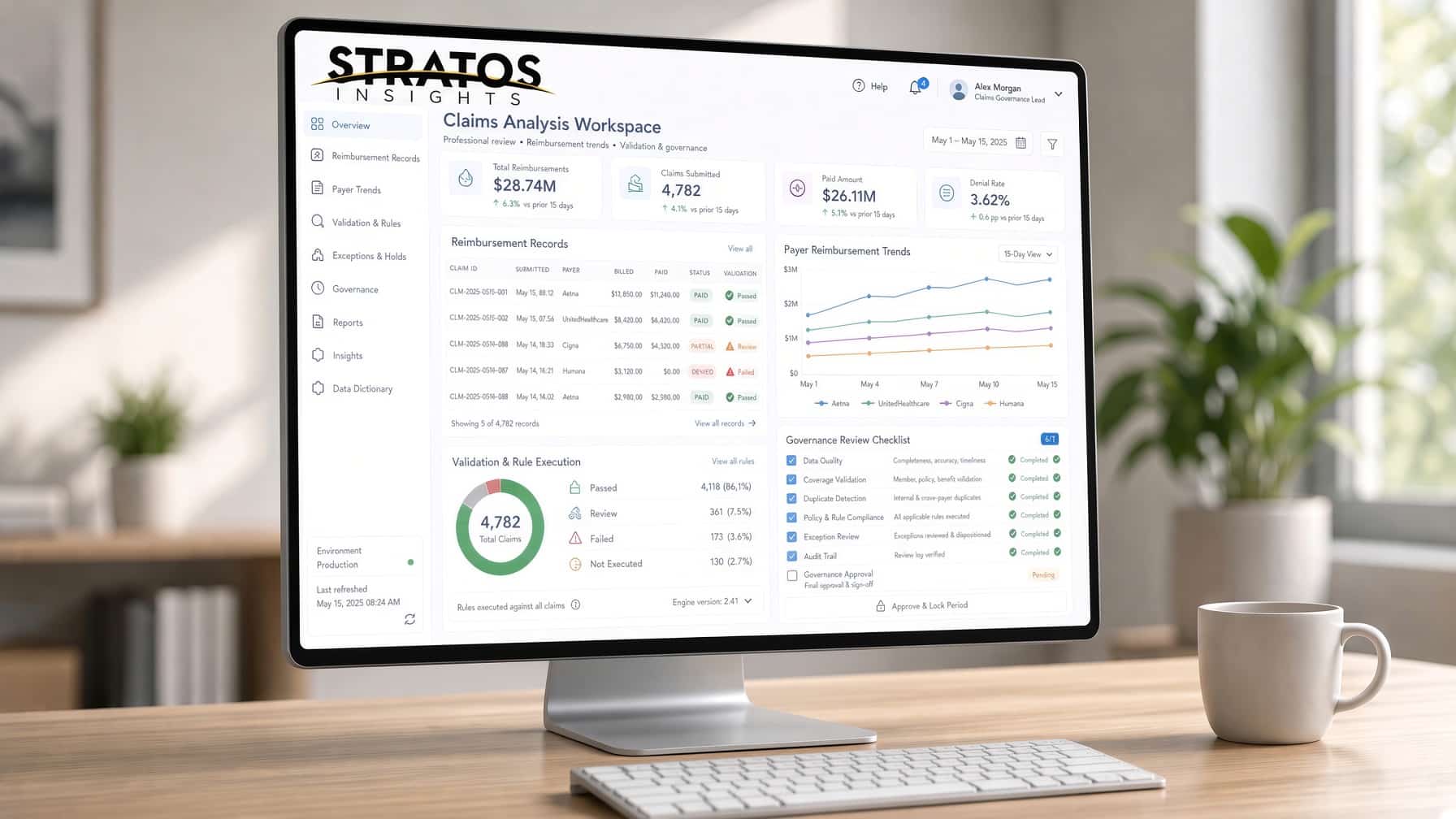
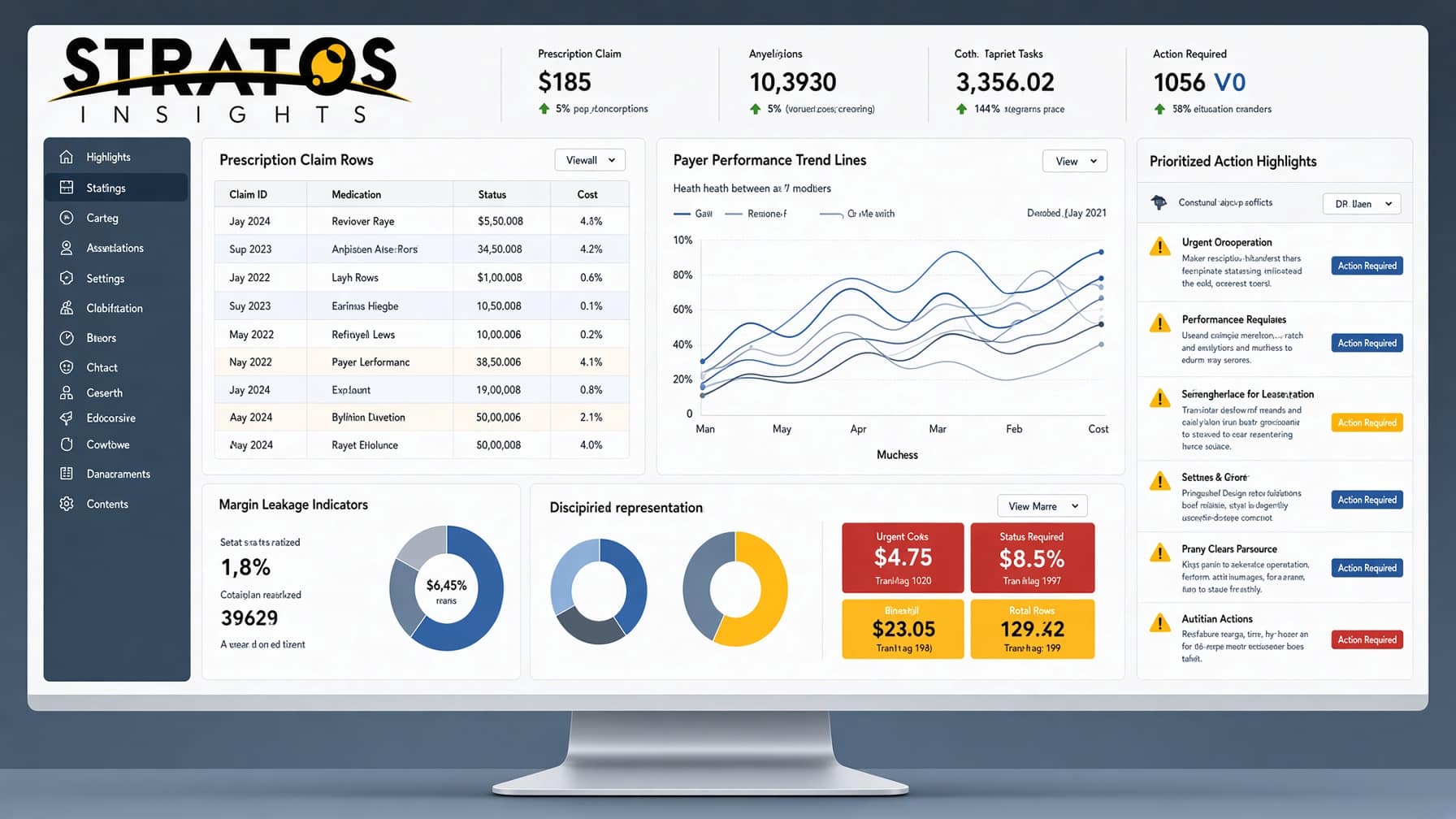
The goal is not to create another dashboard. The goal is to make financial decision-making clearer, faster, and more defensible.
Conclusion: Better Decisions Start at the Claim Level
Claims-level visibility improves financial decision-making because it reveals the transaction-level economics behind broad trends. It helps organizations understand not just what happened, but why it happened and what deserves attention next.
For pharmacy leaders, that means clearer insight into true profitability, payer performance, margin leakage, and operational opportunities. For employers, health plans, and public-sector stakeholders, it means stronger oversight of PBM reporting, reimbursement behavior, and plan performance.
Stratos Insights helps organizations move beyond reimbursement assumptions through independent claims-level analysis, true gross margin visibility, and prioritized financial insight. If your organization needs to make stronger reimbursement, profitability, or oversight decisions, the next step is a focused claims-level visibility review grounded in your actual data.
FAQ
What is claims-level visibility?
Claims-level visibility is the ability to analyze individual prescription claim records and related financial fields to understand reimbursement, cost, payment, adjustment, and margin behavior at the transaction level.
Why does claims-level visibility improve financial decision-making?
It connects broad trends to the specific claims, payers, stores, products, and channels that created them, helping leaders prioritize action based on evidence.
How does claims-level visibility help pharmacy organizations?
It helps pharmacy leaders identify margin leakage, below-cost claims, payer performance differences, purchasing opportunities, and store-level profitability patterns.
How does claims-level visibility help employers and plan sponsors?
It helps employers understand pharmacy spend drivers, validate PBM reporting, review compensation flows, and make better budgeting, renewal, and vendor management decisions.
Can claims-level visibility support public-sector oversight?
Yes. It can help public-sector stakeholders evaluate reimbursement patterns, PBM reporting limitations, below-cost claims, and stewardship questions tied to taxpayer-funded or member-funded benefits.
Is claims-level visibility the same as a dashboard?
No. A dashboard may display metrics, but claims-level visibility should provide the underlying evidence and prioritized analysis needed to support decisions.
When should an organization request a claims-level review?
A review is useful when spend is rising, margin is weakening, PBM reports are difficult to reconcile, payer performance varies, or leaders need a stronger financial oversight record.